
Download the RACI matrix template
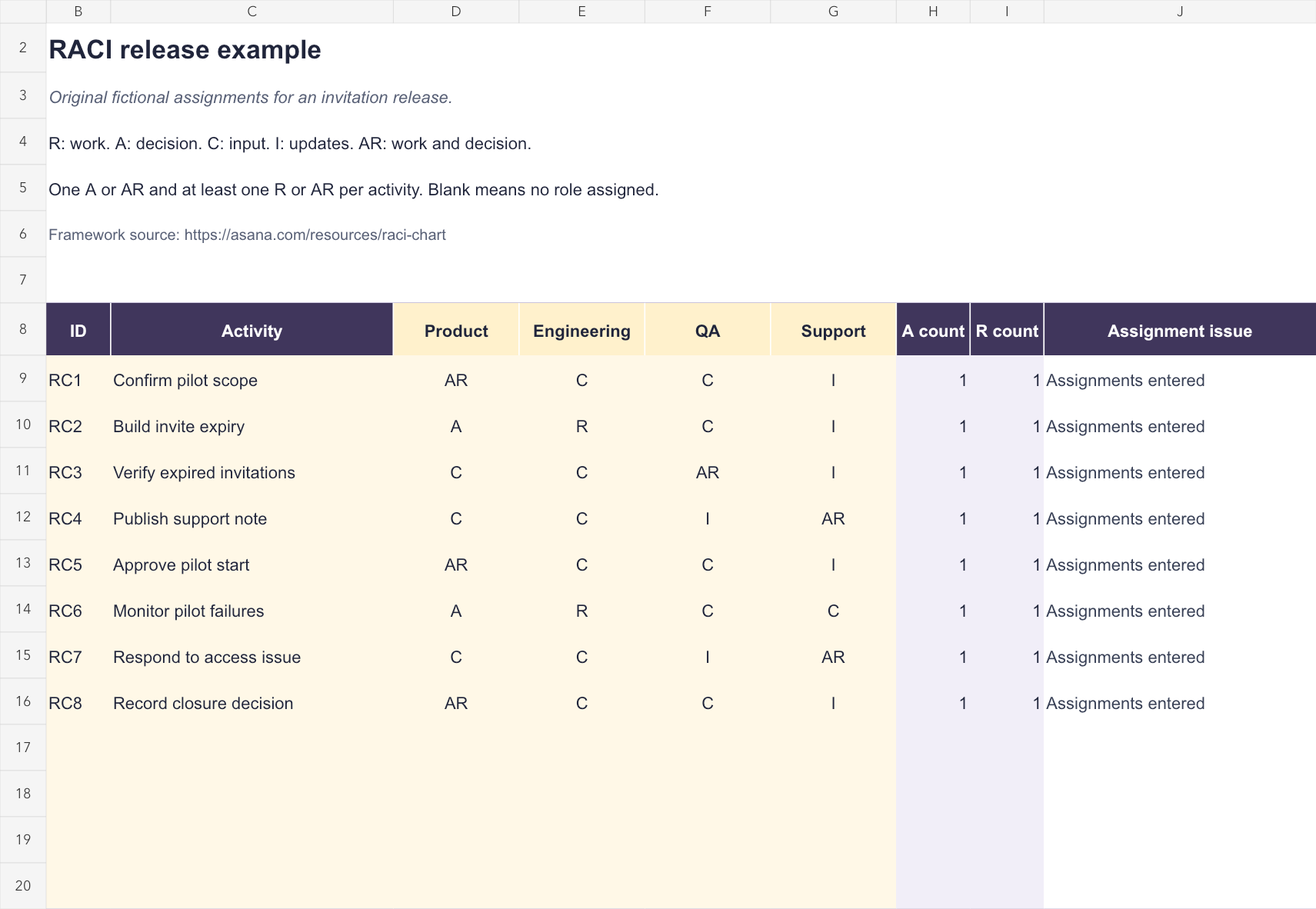
The Excel workbook contains a Release example sheet with eight fictional activities and a Your matrix sheet with twelve prepared activity slots. Each has four editable role columns, calculated accountable and responsible counts, and an assignment issue column. The download is available without registration.
The example follows an invitation-expiry release in a fictional SaaS called InviteDesk. Its assignments are teaching material, not a description of ShowMeYourSaaS staffing or approval authority. Save a copy and replace the activities and role headings before using the workbook with your team.
What do R, A, C, and I mean?
R means Responsible: the person or role doing the activity. A means Accountable: the person or role owning its decision and acceptance. C means Consulted: someone whose input is needed. I means Informed: someone who needs an update. Asana's RACI guide explains this general assignment framework.
This template also accepts AR when the same column owns the work and the decision. Its explicit policy is one A or AR per named activity and at least one R or AR. Several responsible assignments can pass that policy, but the team still needs to clarify the handoff between them.
A RACI chart records an agreement about work. It does not grant database access, change application permissions, prove that someone has capacity, or establish that an activity is complete. Keep those decisions and checks in their appropriate systems.
Use a RACI matrix for a specific coordination problem
Start with the ambiguity you need to resolve. Perhaps engineering believes the founder approves a pilot while the founder expects QA to make that decision. Or support receives a customer question without knowing who can authorize a correction. A small matrix makes those handoffs discussable.
Choose a bounded workflow rather than cataloguing every action in the company. In the example, the activities cover scope, implementation, verification, support preparation, pilot approval, monitoring, an access issue, and closure. The team can review these together without maintaining a giant organizational chart.
Name activities at the level where ownership can differ. Implement invitation expiry and approve pilot start need separate rows because doing the implementation does not automatically own the release decision. Tiny coding steps usually belong inside the implementation task rather than in separate responsibility rows.
| Question | Useful view |
|---|---|
| Who performs, decides, contributes, and receives updates? | RACI matrix |
| When do tasks happen and which dates depend on others? | Gantt schedule |
| What state is unfinished work in today? | Kanban board |
| What behavior should this change provide? | Product requirements document |
Fill in the blank workbook
Open Your matrix. Rename the four yellow role headings in D8:G8. Choose a consistent unit: named people or clearly understood team roles. If one person holds several roles, agree which single column carries that activity's A. The workbook counts assigned cells; it does not identify that two labels represent the same person.
Use rows 9–20 for up to twelve activities. Enter an ID and activity in columns B and C, then put R, A, C, I, AR, or a blank in D:G. A blank means that column has no assignment for the activity. Use AR in that order; combined codes such as RA or R/A are outside this template's accepted set.
Columns H and I calculate the A and R counts. Column J identifies a missing accountable assignment, multiple accountable assignments, a missing responsible assignment, an unsupported code, or an assignment without an activity name. Keep those formulas intact. Assignments entered means the stated cell rules are met; confirm the agreement separately.
The prepared range ends at row 20. If you need more activities or roles, extend and review the formulas and formatting before relying on the new area. Sorting an entire prepared table is different from sorting one role column; keep each activity and its assignments together.
Read the completed invitation-release example
Product owns scope and the pilot-start decision. Engineering performs the invitation-expiry implementation while Product retains its acceptance decision. QA holds AR for verifying expired invitations, and Support holds AR for publishing the support note. These choices illustrate a possible agreement, not a universal allocation of authority.
For the access-issue row, Support owns the response while Engineering and QA provide input. That does not authorize Support to change a customer's permissions. The response can include gathering permitted evidence and routing an authorized change to the appropriate owner.
Discuss the edge between roles before the pilot begins. Who receives a failed verification result? What information does Product need to approve exposure? Who handles an issue while the implementation owner is unavailable? Put the operational steps in an SOP and link the responsibility record to it.
| Activity | Agreement to establish |
|---|---|
| Build invitation expiry | Who accepts the behavior against the agreed criteria? |
| Verify expired invitations | Which checks can QA complete independently? |
| Approve pilot start | Which failed check prevents approval? |
| Respond to an access issue | Who can perform an authorized correction? |
Resolve conflicts and keep the agreement current
If two columns contain A, decide whether the activity is actually two decisions. Split it when appropriate; otherwise name one accountable owner and describe the other person's input. Changing a letter without resolving the underlying disagreement leaves the handoff ambiguous.
If a row has several R assignments, name the division of work and the point of coordination. For a small task, one responsible owner is often easier to follow. For shared work, a short note in the task or SOP can explain the boundary that a single letter cannot capture.
Review the matrix when the workflow, staffing, or release scope changes. Use the Gantt template for dates and the PRD for behavior. A solo founder doing and accepting every task may only need an owner and a completion check rather than a full RACI chart.
How the workbook was checked
We checked the example assignments, removed an accountable role, added a second accountable role, removed a responsible role, and entered an unsupported code. We also used the last prepared blank row, tested AR and multiple R assignments, and checked an assignment without an activity name. Both sheets were rendered for inspection, and the exported XLSX was imported again to verify the calculated results.
These checks used the available spreadsheet calculation and export tools. Native Microsoft Excel was unavailable. When opening the workbook in your spreadsheet application, change an assignment and confirm that the counts and issue text recalculate before depending on your own matrix. Source and workbook checked October 27, 2026.